
When David Koch of dryfusionscotland.co.uk came to us, he already had everything a local service business needs to succeed online. A strong reputation — over 770 five-star Google reviews. A genuinely differentiated product in the patented Dry Fusion cleaning system. A well-established presence in East Lothian. And a client base that was growing consistently through word of mouth.
What he didn't have was a digital foothold in Edinburgh.
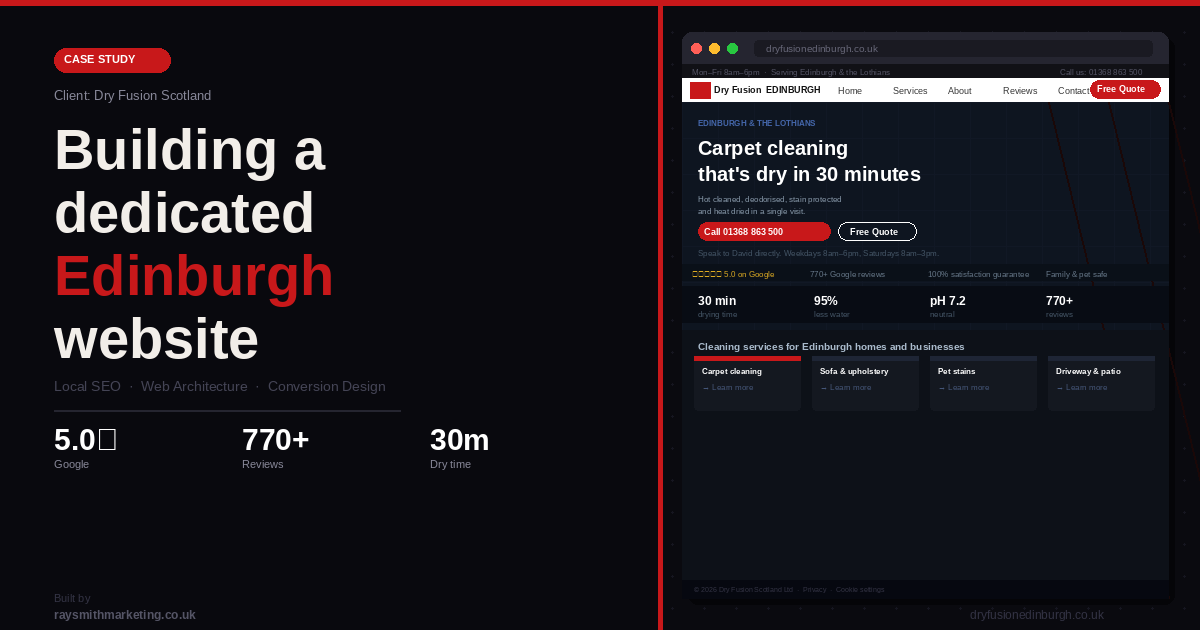
That's the problem we set out to solve. The result is dryfusionedinburgh.co.uk — a dedicated website built specifically to capture Edinburgh and Lothians search traffic and convert it into booked jobs. Here's the thinking behind it, the technical decisions we made, and why the approach works for any local service business operating across a wide geographic area.
The Problem: One Domain Competing in Two Markets
The existing dryfusionscotland.co.uk site serves East Lothian and the surrounding region well. It ranks for the terms that matter in that area, has built up domain authority over several years, and generates a consistent flow of enquiries.
Edinburgh, however, is a different proposition entirely. It's a city of half a million people, a highly competitive local search market, and — critically — a place where Google's local ranking algorithm places significant weight on geographic relevance. A domain named "dryfusionscotland" with an address in Dunbar and content focused on East Lothian is always going to struggle to rank prominently for "carpet cleaning Edinburgh" searches, regardless of the quality of the underlying business.
The solution wasn't to overhaul the existing site. It was to build a second, dedicated domain — dryfusionedinburgh.co.uk — that signals Edinburgh relevance to Google from the URL down, and targets the Edinburgh and Lothians market with content written specifically for that audience.
The Technical Decisions — And Why We Made Them
Domain and URL Structure
The domain itself — dryfusionedinburgh.co.uk — does immediate SEO work. Edinburgh appears in the URL, which Google reads as a strong relevance signal for local searches. Combined with a .co.uk TLD that signals UK geographic relevance, it positions the site correctly before a single line of content is written.
Each service has its own dedicated URL:
/carpet-cleaning/upholstery-cleaning/driveway-cleaning/commercial
This is a deliberate decision. Consolidating all services onto a single page might feel cleaner, but it dilutes the SEO value of each individual service. A dedicated page for carpet cleaning Edinburgh can be optimised specifically for that search term, with relevant content, structured headings, and internal links — without competing for page space with upholstery cleaning or driveway work.
Page Speed and Mobile Performance
Dry Fusion Scotland's existing site runs on WordPress — a solid, flexible platform. For the Edinburgh site, we built on a lightweight static architecture that delivers significantly faster load times, particularly on mobile. Page speed is a confirmed Google ranking factor, and more importantly, it directly affects conversion: every additional second of load time increases bounce rate meaningfully.
The site uses modern WebP image formats throughout, with properly sized images served at the resolution the device actually needs rather than scaled down in the browser. This keeps the visual quality high — particularly important for before/after photography — while keeping file sizes low.
Structured Data and Schema Markup
Every page on the new site includes correctly implemented LocalBusiness schema markup, telling Google explicitly: this is a local service business, this is its service area, this is its contact information, these are its opening hours. This is the kind of technical detail that doesn't show up on the page but makes a measurable difference to how Google interprets and surfaces the site in local results.
The reviews schema is also implemented, meaning the site's 5.0 Google rating has the best possible chance of appearing as rich snippet stars in search results — one of the most significant click-through rate drivers available to a local business.
Geographic Content Targeting
The site explicitly names the areas it serves: not just Edinburgh, but Leith, Portobello, Morningside, Stockbridge, Corstorphine and every other area of the city where potential customers are searching. It names Midlothian towns — Dalkeith, Bonnyrigg, Penicuik — and West Lothian locations including Livingston, Bathgate and Linlithgow.
This isn't keyword stuffing. It's the way Google understands service area businesses. A plumber in Edinburgh doesn't just serve "Edinburgh" — they serve specific postcodes and neighbourhoods, and potential customers search for those specific places. The content reflects that reality.
Conversion Architecture
Traffic without conversion is just a vanity metric. The Edinburgh site is built around a clear conversion path from every page: a persistent phone number in the header, a click-to-call button that works on mobile, and a free quote form that doesn't ask for unnecessary information.
The FAQ section directly addresses the questions that cause potential customers to hesitate — how does 30-minute drying work, is it safe for children and pets, what does it cost, what if I'm not happy. These are the objections that sit between a visitor and a booking. Answering them on the page removes friction rather than leaving it to a phone call.
The before/after image slider is not decorative. For a service business where the result is the product, showing real transformations from real Edinburgh homes — no staging, no filters — is the most effective conversion tool on the page. It does the selling that no amount of copy can match.
Why This Approach Works for Local Service Businesses
The Dry Fusion Edinburgh site is a specific solution to a specific problem, but the underlying strategy applies to any local service business operating across multiple geographic markets.
A single domain rarely ranks well across a wide area if that area spans genuinely distinct local search markets. A plumber based in Livingston who wants Edinburgh work, a cleaning company in Dundee targeting Perth, a landscaper in Stirling pushing into Glasgow — all of these businesses face the same challenge David faced. Geographic relevance is one of the most significant factors in local search ranking, and a domain, address, and body of content all pointing to one location will always struggle to rank prominently in another.
The answer is not always a second website. For businesses with a single, tight service area, the existing domain should be optimised properly and the effort goes into content and links. But for businesses where the revenue opportunity in a second market is significant enough to justify the investment — and where the existing domain is anchored somewhere else — a dedicated second domain is often the right call.
It's a decision that requires honest assessment of the opportunity versus the cost. That's exactly the kind of conversation we have with clients before recommending anything.
The Result
(dryfusionedinburgh.co.uk) is live, fast, and built to rank. David is delighted with it — and with good reason. It gives Dry Fusion Scotland a genuine presence in the Edinburgh market for the first time, backed by the same 770 five-star reviews and 30-minute dry time guarantee that built the business in East Lothian.
We'll be tracking rankings and organic traffic over the coming months and will report back on what the data shows. Watch this space.
Ray Smith Marketing builds websites and marketing strategies for small businesses that want real results rather than impressive-looking reports. If you're a local service business looking to grow into a new area, get in touch (www.raysmithmarketing.co.uk).